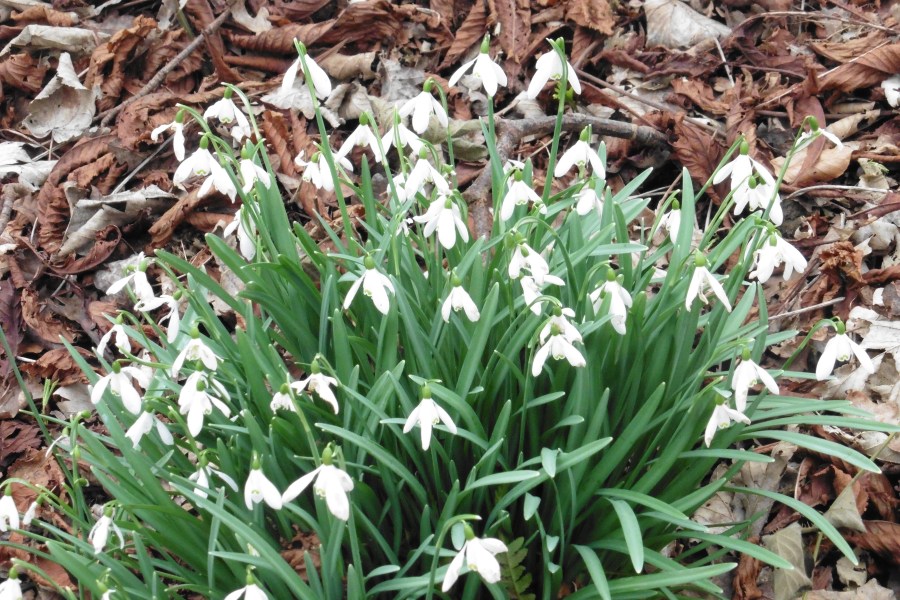
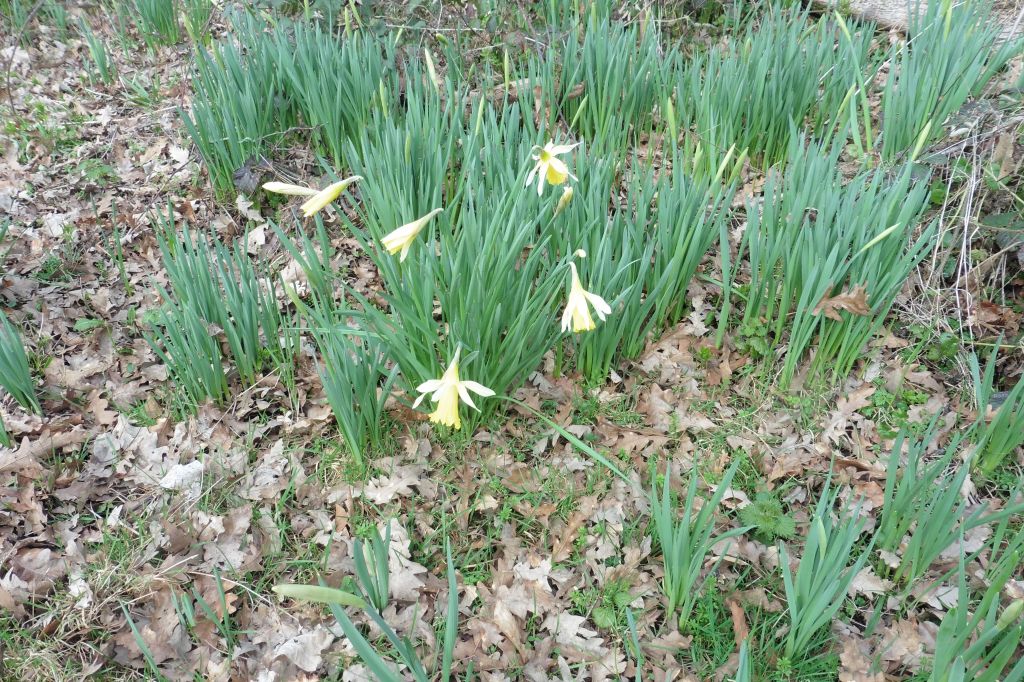
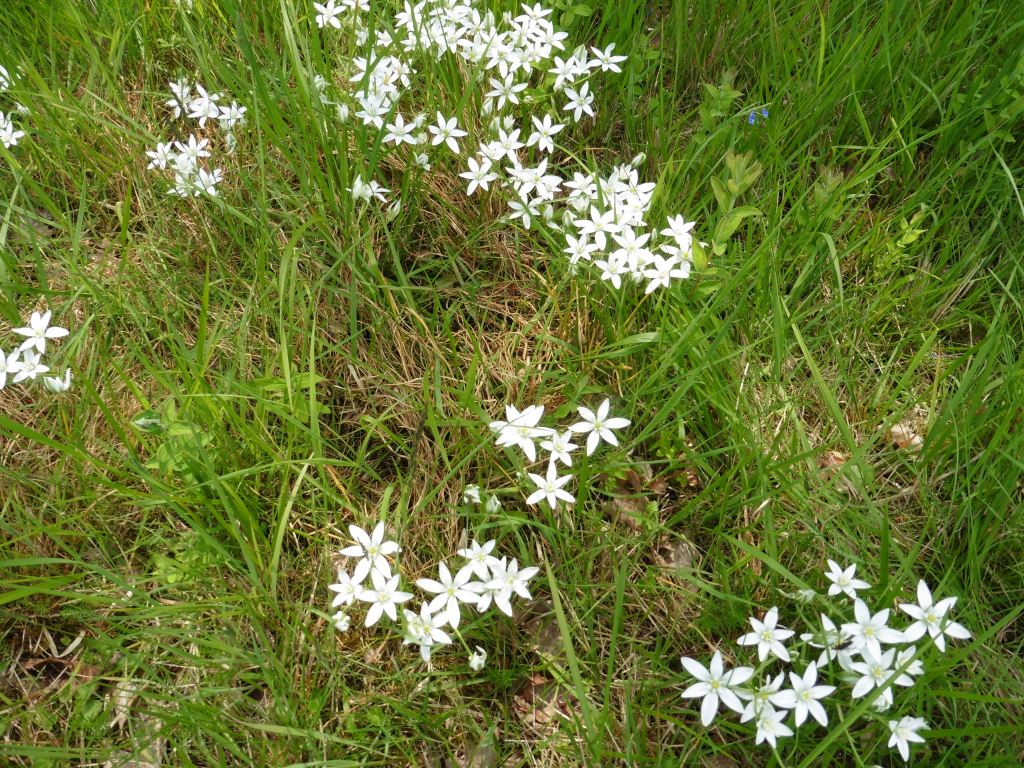
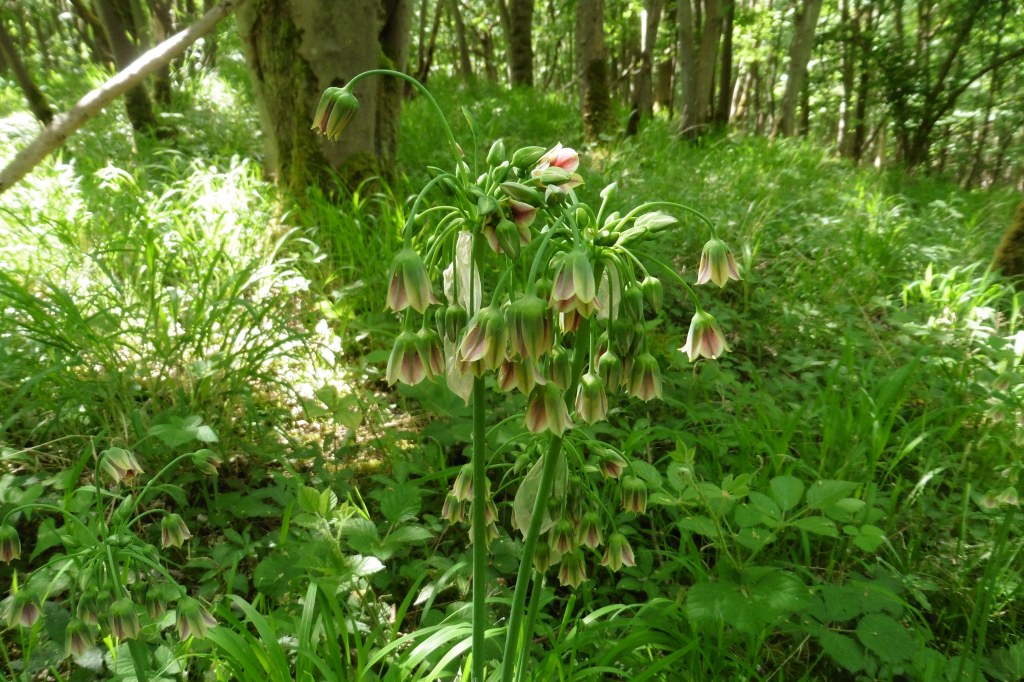
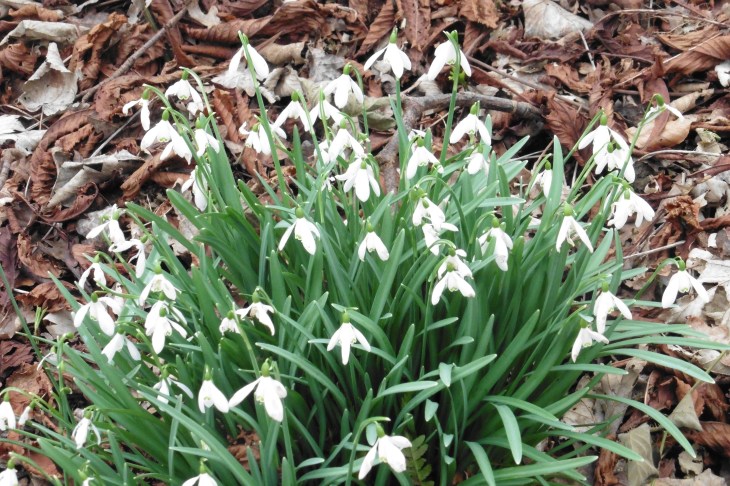
The snowdrops are coming into bloom in the woods on the top of Wytham Hill; soon there will be the (garden variety) daffodils and even a plant or two of star-of-Bethlehem: all non-natives, but I will enjoy their beauty none-the-less. They are part of the story of the Woods, mostly probably planted in the 1920s.
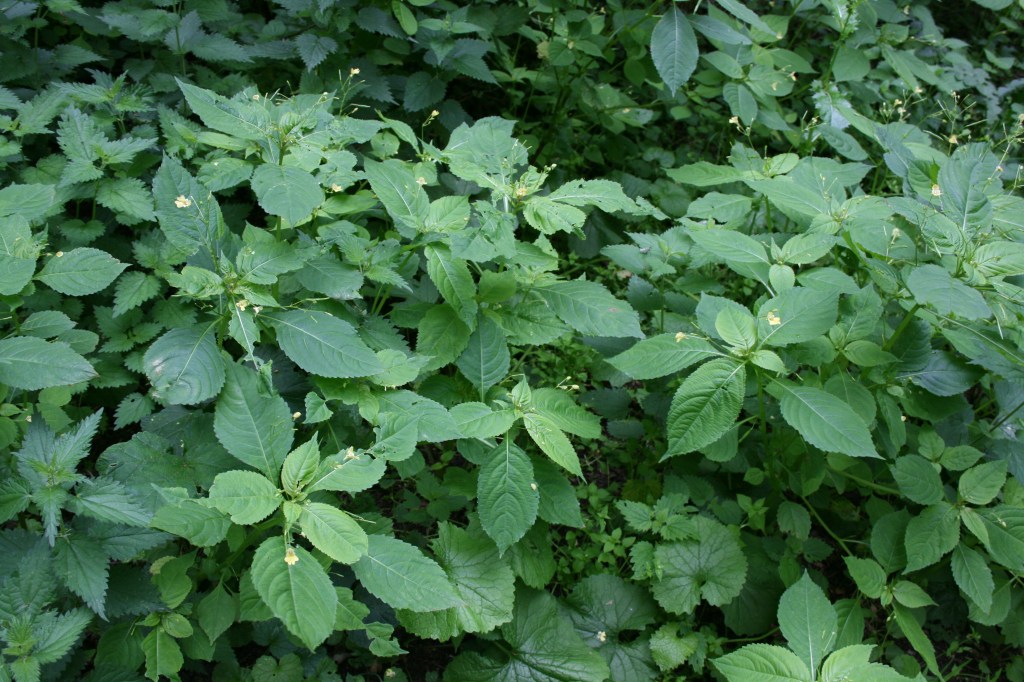
On the other hand I pulled up the Himalayan balsam that was starting to creep in where the woods meet the Thames; I did similarly for its cousin the small balsam where it was establishing along rides (but it has established elsewhere); I may have a blitz this summer on the Sicilian honey garlic that is appearing through the Woods. I am, as I suspect, are others in the conservation sector, inconsistent with regard to non-native species. We accept (or don’t worry about them in some places), but dislike and remove them in others; we enjoy seeing some, react badly to others.
Native plants are defined as that those that arrived in Britain without human assistance, generally some time before the spread of Neolithic farming cultures. Of course natural colonisation did not stop with the development of farming but it becomes increasingly difficult to be sure that a species arrived without human assistance as the debates about the Lusitanian element of the British and Irish flora illustrate. These are species found in the west of Ireland and a few in south-west England, but otherwise in the Mediterranean Region: were they stowaways on Phoenician ships that sailed to these isles seeking copper and tin?
As part of a collection I am making for the University Herbarium I have picked up a variety of introductions growing along the lanes through the Wytham Estate: Canadian golden-rod, everlasting pea; I will be surprised if at some point I don’t find montbretia. They all garden escapes, but then so are my specimens of British-native greater celandine and Welsh poppy from this habitat. One of Oxfordshire’s rare plants can also be found on these verges – birthwort – an early introduction grown for its medicinal value. They all add colour and interest to the verges; does their nativeness (or lack of it) matter in this artificial habitat?

If our definition of nativeness is based on the idea of species having got here without human assistance, should we consider taking account of the degree of human alteration stops this happenning? We have profoundly altered the extent and composition of the habitats from which new species might come to Britain, and into which they might establish when they arrive. are human-modified. We have interfered with dispersal processes, for example by eliminating important animal vectors and reducing the likelihood that floating masses of vegetation might be swept down the Continents big rivers and across the Channel. We are altering the climate so that the speed at which species might need to spread to stay in their preferred conditions has greatly increased.
Assisted dispersal is already well-established in re-introduction work; I am looking forward to the time when expanding populations of ospreys and white-tailed eagles join the red kites circling over Oxford; but what about assisted introductions, or more acceptance of species jumping the garden wall into the wild. We may fall back on the argument that some of these plants are very invasive and can become ‘over-dominant’ – that is why I pulled up the Himalayan balsam. However some native species behave the same – bracken, dog’s mercury – and of course my brambles.
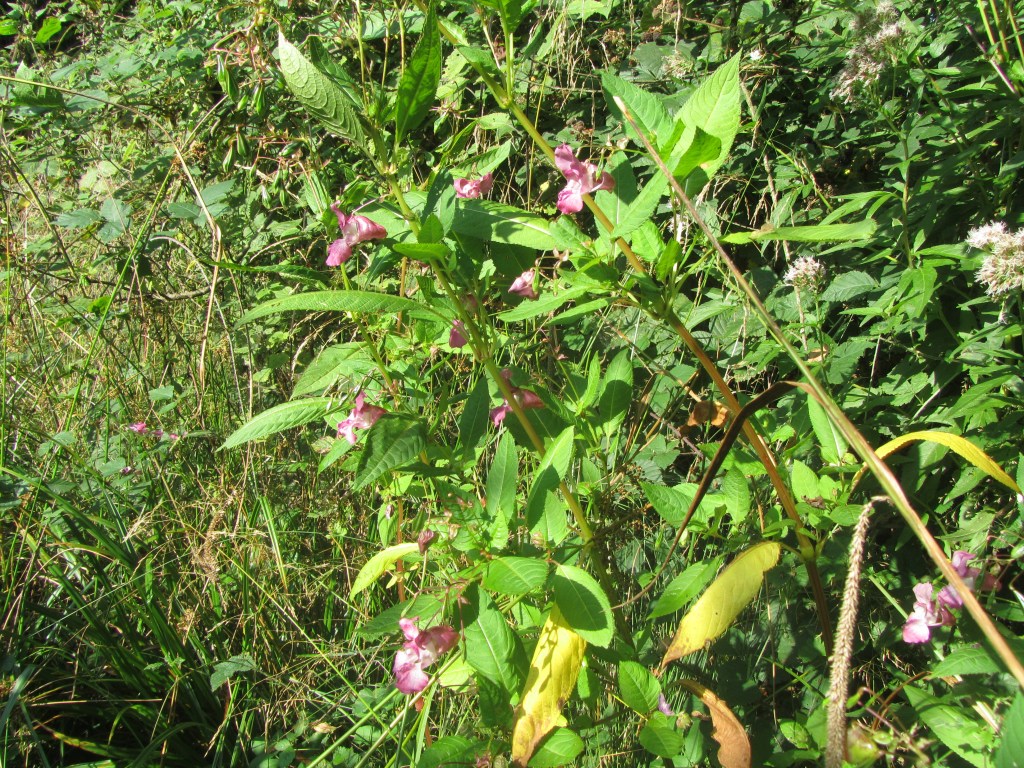
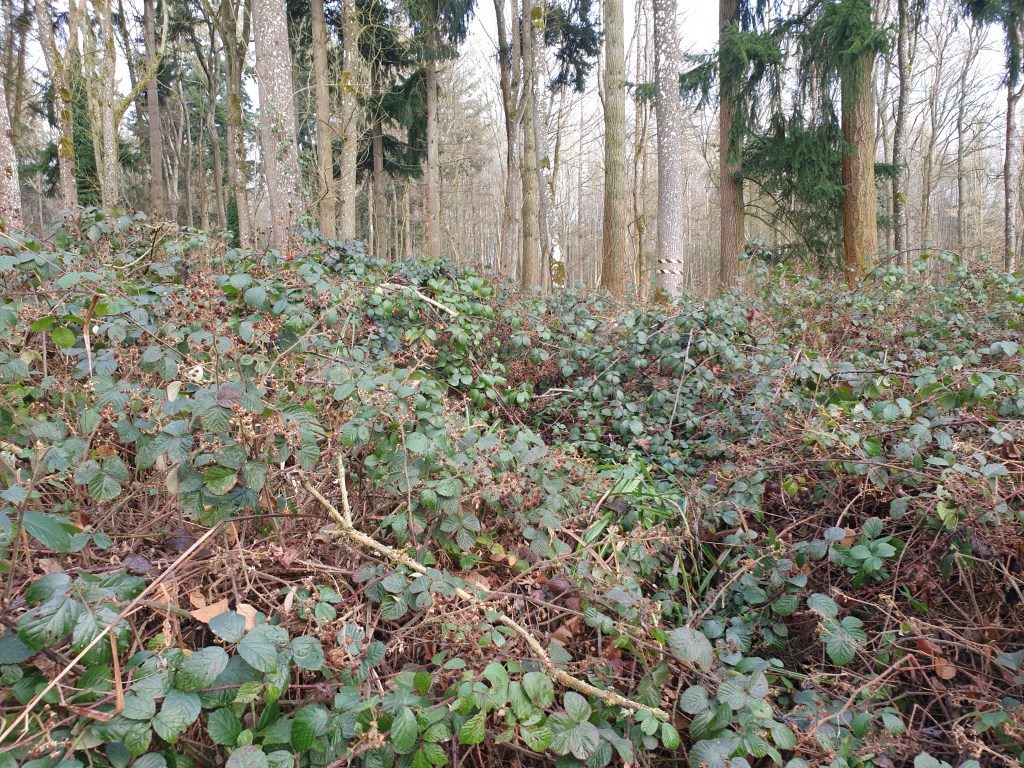
Which is the bigger thug: Himalayan balsam or bramble?
I think that some introduced tree species should be being considered in places as part of the future-natural composition of our woods; I need to start thinking how that logic might be applied to ground flora species. I suspect it will end up being on a species-by-species basis, site by site basis. Are there existing ground flora plants in this wood, in this habitat that will be compromised by allowing a particular new species to spread. Do the new species bring other benefits, as hosts or food plants for invertebrates for example? Will we find that some apparently ‘invasive’ plants settle down after a generation or two and become just another species in the local assemblage?
I don’t think we should just accept anything that can jump the garden fence or arrive with a consignment of olive bushes everywhere, but equally we cannot stop all species spread. So should we be deliberately leaving some woods (or parts of woods) to be invaded; even perhaps setting up experiments where we introduce species that we think might be part of future assemblages with climate change? Should I put my honey garlic campaign on hold?

 The Old Man of Wytham
The adjective invasive might help, as I think that tends to influence our response to non-native plants (BSBI define native as arrived without human interference since the end of the last glaciation, or was already present and survived the glaciation – although who was around to make a list?). However some plants behave differently eg sycamore which seems to occupy the niche vacated by elm in the north, but can be invasive in southern woods. But it is I think a bit arbitrary. For example it is accepted beech got here under its own steam, so considered native in the south. Yet it probably would be spreading northward anyway with human help, and would sycamore have arrived by now under its own steam? Don’t know about honey garlic, but on the footpath by us there is an invasive colony of few flowered leek – which has annoyingly just appeared on my veg patch. Still, as Rackham said of ramsons, it is a welcome addition to peanut butter sandwiches!
LikeLike