
The Old Man’s run-up to Christmas started as usual with the British Ecological Society’s Winter Meeting, held this year in Belfast. Prior to the meeting I got the bus out to Belvoir Park on the outskirts of the city, to see the ‘Belvoir Oak’ reputedly 500 years old and possibly the oldest oak in Northern Ireland. The point on Google Maps did not have any apparent path to get to it and a local out for a walk was dismissive of that location – ‘no, I think it is the tree up near where the big house was’. I duly photographed that tree – certainly impressive, but quite what I was expecting.


Two ancient trees that are not the Belvoir Oak!
My informant recommended a walk back along the Lagan to the city centre and I set off down the hill. This path swung me round to roughly where Google Maps said the Belvoir Oak should be. There were some elderly if not ancient-looking parkland trees, from the look of it recently released from plantation. Another walker appeared with half a dozen dogs: she said that the Belvoir Oak was just up the path, so I did eventually get the correct tree photographed, before a pleasant walk back into the city.
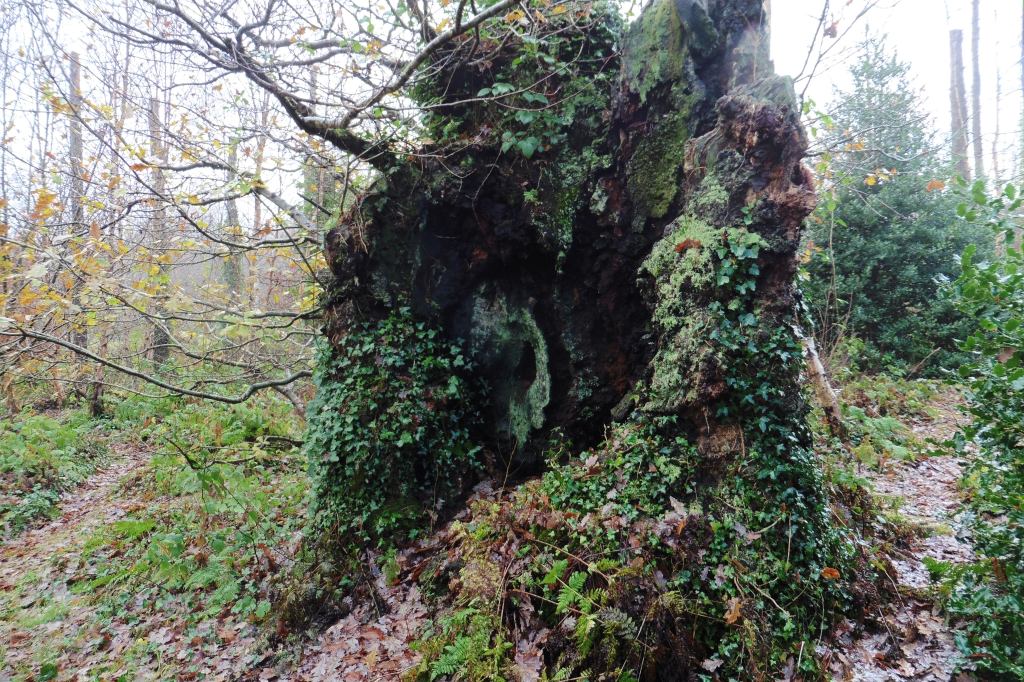
The real Belvoir Oak.
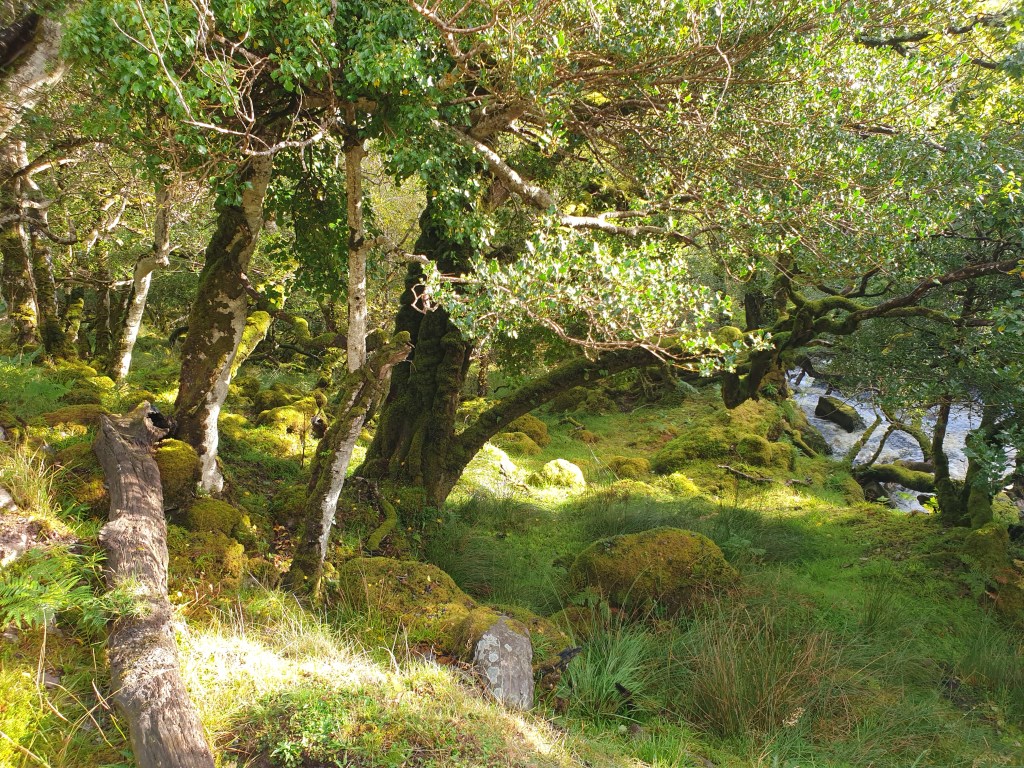
The conference itself was the usual mix of good posters and talks, plus a lot of catching up with old friends. There were presentations on Atlantic rainforests in Ireland and litter raking experiments in the Czech republic; various presentations on the impact of ash dieback on woods and bat use of woodland edges. Biodiversity targets, their monitoring and the use of different metrics were also a popular theme.


A talk on agricultural expansion challenged us to think about our global food footprint. Can we reduce food waste and shift to a plant-based diet quick enough in Britain to justify reducing food production for what are, globally, relatively insignificant biodiversity gains, without this leading to increased off-shoring of biodiversity losses through increased imports – the same sort of argument could be applied to forest production. Then in amongst the increasingly sophisticated models of how species and populations change came a plea not to neglect the basic studies of the biology and growth of species on which such models depend.
As a break I attended a lunchtime workshop on nature writing, where we all had ten minutes to write a short poem or essay paragraph on an ecological issue. My attempt was on radioactive pollution, not that I know anything about it but the guy behind me said he worked in the field, studying what happened in Chernobyl.
Unseen, after the first flash
Ubiquitous, in every breath, every stomatal gasp
Unstoppable, the changes at the cell level
Unknown, the effects emerging over years
Unaccountable, those who allowed it to happen
Understanding needed of what good might yet come.
It was certainly a change from formal scientific writing, but the point was made that there are similarities between that and poetry: both scientists and poets are trying to get across ideas in a concise way, abiding (to a greater or lesser degree) by certain conventions within the genre. It also seems to me that while authors (scientific or poetic) may be very clear what they mean, someone coming to that writing fresh may struggle with: interpreting the imagery whether these are poetic metaphors or PCA-diagrams. Throughout the conference there was generally much more emphasis on communicating our science to non-scientific audiences than in the past. Perhaps by more poetry – Thomas Tusser in the 16th Century promoted good farming practice through rhyming couplets in Five Hundred Points of Good Husbandry; Erasmus Darwin (Charles’s grandfather) promoted the Linnaean System of plant classification through The love lives of plants; and close to home Sarah Watkinson writes poems based on research in Wytham Woods https://sarahcwatkinson.wordpress.com/2021/12/27/photovoltaic/
For nearly four days I was cocooned in a green world, surrounded by stunning images of the natural world. There was lots of evidence for the threats to biodiversity in Britain and Ireland, and worldwide, but also a sense of optimism that perhaps governments were finally starting to take action.


The River Lagan between Belvoir Park and Belfast City Centre.
It was therefore a stark contrast to this and my walk back from Belvoir Park to walk out after the meeting to the ferry terminal (the bus drivers were all on strike) through a grey, grimy world of industrial estates, thundering lorries and speeding cars – almost the only pedestrian along a four-mile route.


 The Old Man of Wytham
Great update Keith, and good to see the photos of both the Belvoir oak and less celebrated trees! Sorry to miss you (and the conference) this year but I was in Costa Rica! Which also has some magnificent trees, and many many frogs
LikeLike
A hard choice – rain + forests + Belfast, or rainforest+Costa Rica!
Have a great Christmas. K
LikeLike