
May’s contribution was delayed till now because the Old Man has started re-recording the 164 Dawkins’s plots in Wytham Woods – we are a quarter of the way through. The plots were last looked at in 2018 when Ash Dieback had just arrived and most of the Woods were still free from the disease. Now there are signs of diebac, almost wherever there is ash. Affected trees included one tree showing 90% dieback that was over 40 cm diameter, i.e. it is not just saplings and young trees that are being hit. There are more sounds of branches dropping – or perhaps that is just my heightened awareness when they happen, although nothing has fallen close-by yet.
The Woods seem to be becoming more brambly – this was happening before 2018, in part a response to lower deer numbers, but dieback is also contributing. Ivy on the ground is more prevalent which may also be linked to the deer reduction.

So far however, the most intriguing observation has been the greater frequency of hedge garlic Alliaria petiolata. In 2018 we speculated that increased nitrogen levels could lead to its further expansion, and it looks as if that is the case. Hedge Garlic, as its name implies, is common in hedges and wood-edges on moist, relatively fertile soils, where there is some disturbance.
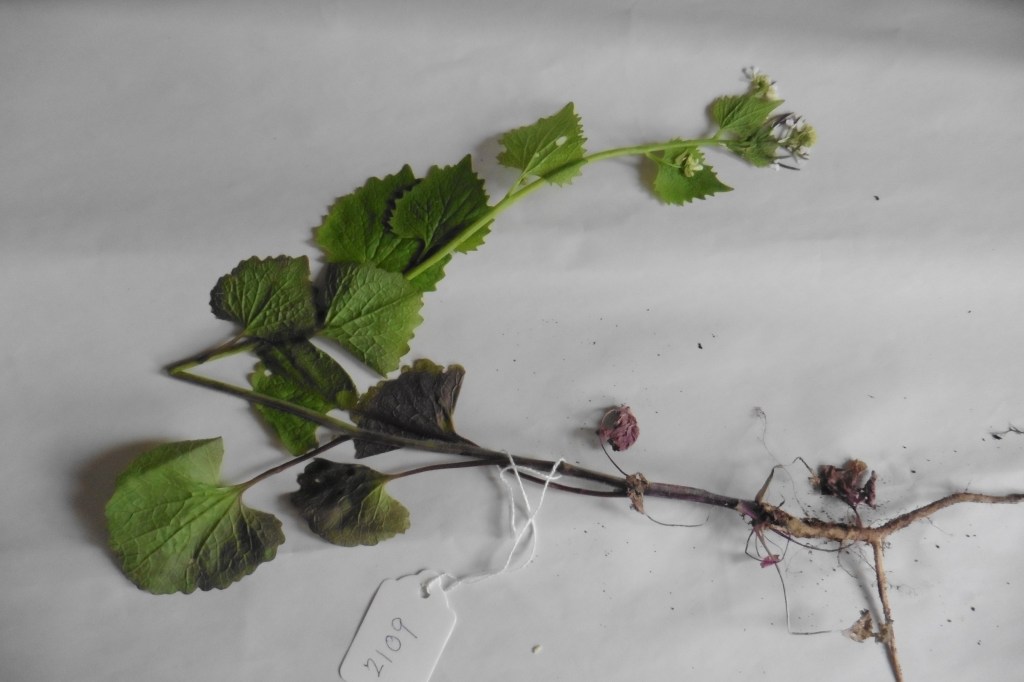
It is not unattractive and is one of the food plants for the Green-veined White butterfly, whose caterpillars feed on the leaves of Hedge Garlic. It is also a food plant for the Orange-tip butterfly caterpillars that feed mainly on the flowers and developing seed-pods. In the early 1990s a study of the butterfly at Monks Wood in Cambridgeshire commented that Lady’s Smock was then the only caterpillar host present. on site. By 2016 Hedge Garlic was also common towards the edges of the wood as at Wytham, presumably because of increased nitrogen coming off the adjacent fields. So, the spread now seen at Wytham may be happening more widely.
Moreover, hedge garlic has form. It is one of several woodland plants (purple-loosestrife and false brome are others) that have become invasive in woodland in parts of the mid-western and north-eastern United States and Canada, displacing the indigenous ground flora. Once established hedge garlic becomes a permanent part of the community, slowly increasing and taking advantage of any disturbance that happens.
When railing against introductions to Great Britain such as Himalayan Balsam or Japanese Knotweed it is easy to forget that our plants and animals can be just as troublesome elsewhere. Our legacies of colonialism include the gorse thickets in New Zealand, foxes in Australia and perhaps even the invasive earthworms in North American forests.

Even if we wished to, there is probably little we can do about the invasion of Wytham by hedge garlic. It is the latest in a string of increases and decreases of native species in Wytham over the last 50 years. Moreover, people who collect wild plants for food value its leaves which do taste of garlic when crushed. In America it has been reported that the leaves can have a higher concentration of vitamin C than oranges and higher levels of vitamin A than spinach. So, is the answer to its spread to encourage more foraging?


According to Grigson in his Englishman’s Flora (and what would he title it these days?), it was mostly know as Jack by the Hedge, or similar. Only in Leicestershire does he record it as known as ‘Hedge Garlick’. Although Culpepper in his herbal does refer to it as Garlic Hedge-weed, ‘or as some foolishly call it Jack by the Hedge’. Who knows why one particular colloquial name gains ascendancy?
LikeLike
I think Jack by the Hedge was my childhood name for it in Essex; not sure when I started using the Leicestershire form.
LikeLike