
There is a general mantra that to make our tree cover more resilient to climate change and to other threats it would be a good idea to encourage more diversity in our tree species cover. At present a handful of conifers provide most of our wood production, while a similar number of broadleaves dominate in our semi-natural woods. At one level the case for diversification is obvious: the impacts of Dutch Elm Disease were particularly severe where most of the hedgerow trees (and quite a few hedges) were elms; our wood production depends heavily on Sitka spruce and if a pest starts to spread through the great forests of western Britain, or the climate were to become too dry for Sitka then we are in trouble.

Almost wall-to-wall Sitka
Implicit, sometimes explicit, benefits claimed for intimate mixtures of trees (where individual trees or small groups of trees of different species grow together) is that they are more productive, but the evidence for this for British conditions is variable, with often a tendency for the more productive species to increase in dominance long-term (Mason and Connolly, 2020). Mixtures may be more robust to pests and diseases but this depends on the individual situation – increases in damage can occur with some mixtures (Field et al., 2019, Field et al., 2020, Vehviläinen et al., 2007). The benefits of mixtures often derive from trait differences between trees (Jactel et al., 2017), again emphasising that it is which tree species are in the mixture that is important, not just that it is a mixture.
There may be disbenefits associated with intimate mixtures. An individual landowner who grows mixed timber stands may find it difficult to market them because she or he does not have enough of any one species at a given time to make up a lorry load. An intimate mix of species may provide a pleasing variety of scenes to someone walking through that wood who sees first an oak, then a beech, then an ash etc. However, viewed from across the valley the patterns of the different canopies merge and the whole wood may look uniform. Moreover not all desired benefits require intimate mixtures: at a national scale we could diversify our productive forest cover, making it more resilient to threats to particular species, while still growing each species in monoculture stands for ease of managenment.
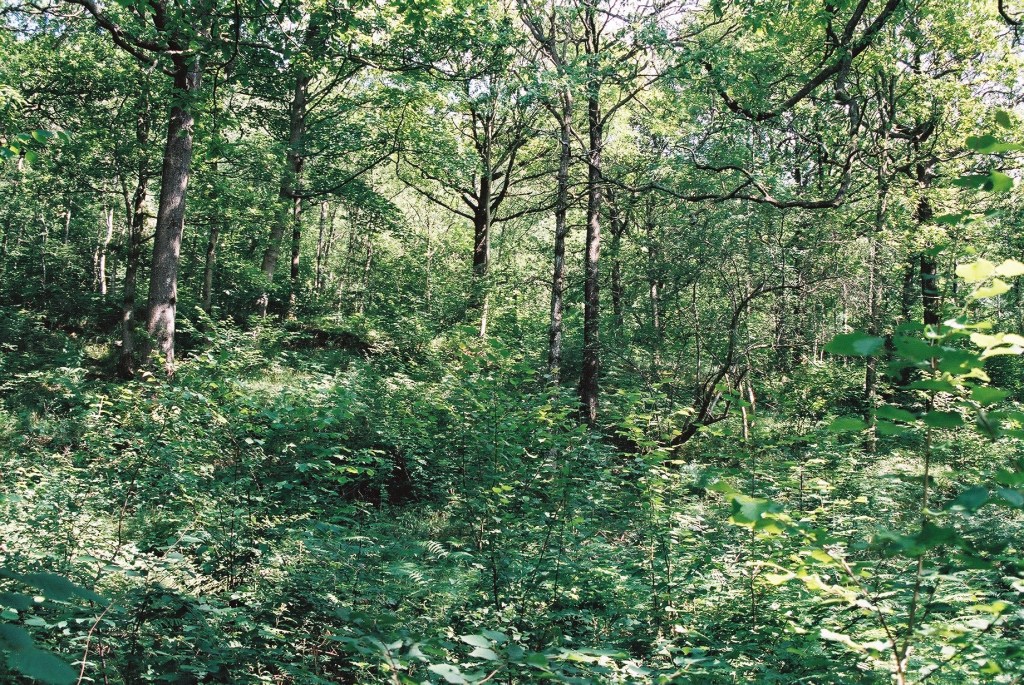

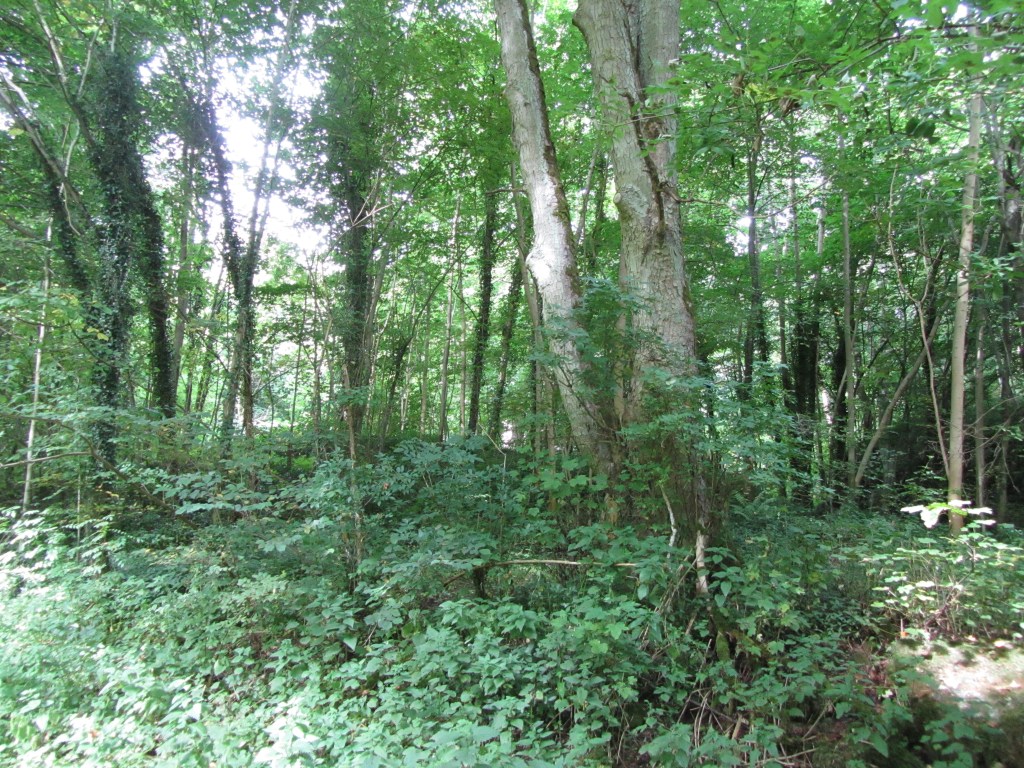
Internal and external views of a mixed woodland.
Adding new tree species to a semi-natural woodland is likely to increase the range of other organisms present because in an oak-ash wood there are the species that live on ash as well as those that live on oak. However, at what point is the benefit of extra associated species brought in with the ash off-set by the disbenefit of reduced populations of oak specialists?
Part of the distinctive character of British semi-natural woods is that we have a depleted tree-species mix compared to the Continent because we became an off-shore island before some post-glacial tree migrations had reached us. For example, we have a higher proportion of ash in our woods on soils which on the Continent might be dominated by beech or sycamore. Do we help to continue the process of re-colonisation in order to create more resilient mixed woods, or retain our impoverished distinctiveness?
Ash on limestone in Derbyshire that might be beech on the Continent.
Our history of woodland clearance and use has also left its mark. Small-leaved lime was more common in hte past but now is generally a relict species, slow to recolonise new woodland even within its former range. Should we be reintroducing it to sites as part of increasing the mixtures?
Oak coppice in western Britain, from Cornwall to Argyll, was encouraged to meet the tanbark and charcoal markets to the near exclusion of other trees; There is generally support for letting these woods become more mixed through regeneration of rowan, holly and birch in gaps leading to a reduction in the abundance of the oak.
In historic parks and wood-pastures old oaks frequently form the majority of the trees, because they can survive for centuries under high grazing pressure. Diversifying wood-pastures is a more tricky process; allowing regeneration of other tree species may threaten the survival of the individual old oaks by over-topping them if the density and position of the new growth is not carefully managed. On small sites there may not be the space to increase the range of tree species if the current oak population is also to be maintained.
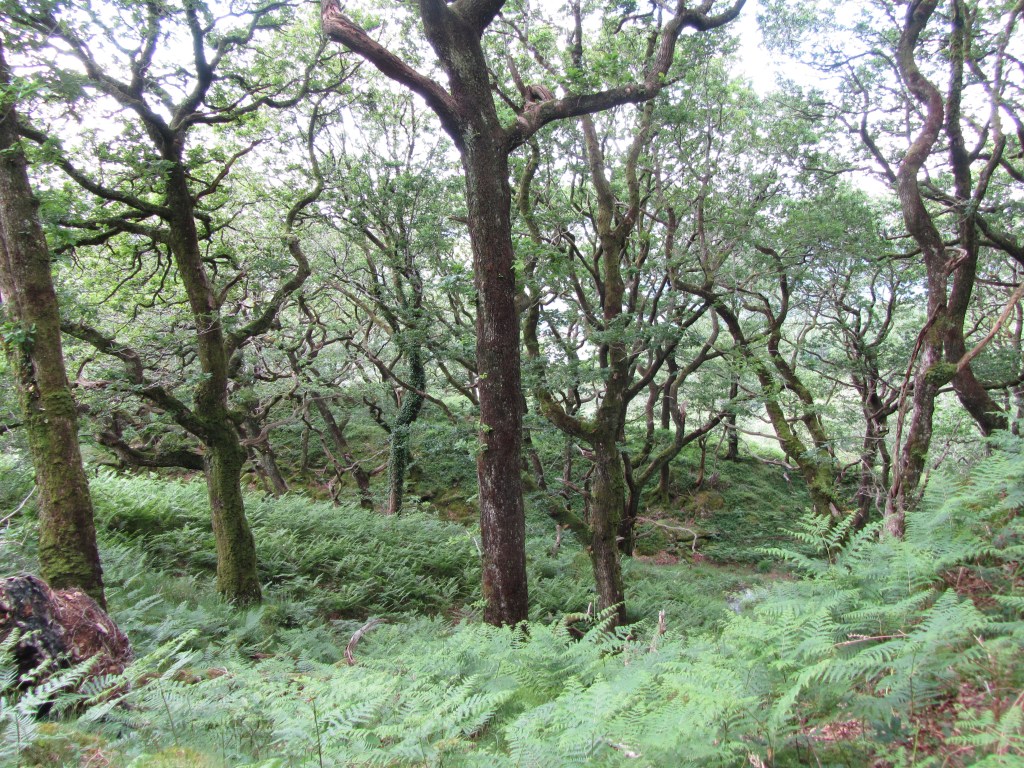

Almost pure oak SSSIs: the first a former coppice stand which could easily be allowed to become more mixed; in the second there is limited space to encourage other species without threatening the old oaks.
The gains, whether in wood production, biodiversity, or increased protection against damage, from developing a mixture compared to single tree species stands have their limits. A mixed stand may show greater resistance to windblow, but still blow flat when there is a very severe storm. An ash tree mixed amongst other species may have a reduced risk of infection by spores of Hymenoscyphus fraxineus, but once it does become infected the consequences for it may be just as serious as if it were in an ash stand. A mixed stand might be producing more timber volume but if the costs of managing the mixture outweigh the increased value, is it worth it?
As a generalisation we want and need more mixed woodland, but what that means at an individual site level will vary greatly.
FIELD, E., CASTAGNEYROL, B., GIBBS, M., JACTEL, H., BARSOUM, N., SCHÖNROGGE, K. & HECTOR, A. 2020. Associational resistance to both insect and pathogen damage in mixed forests is modulated by tree neighbour identity and drought. Journal of Ecology, n/a.
FIELD, E., SCHÖNROGGE, K., BARSOUM, N., HECTOR, A. & GIBBS, M. 2019. Individual tree traits shape insect and disease damage on oak in a climate-matching tree diversity experiment. Ecology and Evolution, 9, 8524-8540.
JACTEL, H., BAUHUS, J., BOBERG, J., BONAL, D., CASTAGNEYROL, B., GARDINER, B., GONZALEZ-OLABARRIA, J. R., KORICHEVA, J., MEURISSE, N. & BROCKERHOFF, E. G. 2017. Tree diversity drives forest stand resistance to natural disturbances. Current Forestry Reports, 3, 223-243.
MASON, W. & CONNOLLY, T. 2020. What influences the long-term development of mixtures in British forests? Forestry: An International Journal of Forest Research.
VEHVILÄINEN, H., KORICHEVA, J. & RUOHOMÄKI, K. 2007. Tree species diversity influences herbivore abundance and damage: meta-analysis of long-term forest experiments. Oecologia, 152, 287-298.

 The Old Man of Wytham